
Peptide Therapy:
The complete guide
What peptides are, how they work, what the research shows, and why they’ve become one of the most talked-about tools in modern health optimisation and recovery research.
What are peptides?
Peptides are short chains of amino acids — the same building blocks that make up proteins. The difference is size: proteins are long, complex chains of hundreds or thousands of amino acids, while peptides are much shorter, typically containing between 2 and 50 amino acids.
Your body already produces thousands of peptides naturally. They act as signalling molecules — chemical messengers that tell cells what to do. Hormones like insulin and glucagon are peptides. Growth hormone releasing hormone is a peptide. The compounds responsible for regulating inflammation, tissue repair, and immune function are largely peptides.
Peptides are the body’s own language. Peptide therapy is about learning to speak it more fluently — using specific compounds to amplify signals the body already understands.
Peptide therapy in a research context refers to the use of specific synthetic or naturally derived peptides to study their effects on the body. Researchers use them to study everything from muscle recovery and tissue repair to metabolic function and neuroprotection.
How peptide therapy works
Because peptides are structurally similar to the body’s own signalling molecules, they can interact with specific receptors on cell surfaces with high precision. This receptor specificity is what makes peptides so interesting — rather than broad, systemic effects, many peptides target very specific biological pathways.
Receptor binding
The peptide binds to a specific receptor on the surface of target cells — like a key fitting a lock. Different peptides target different receptors in different tissue types.
Signal transduction
Binding triggers a cascade of intracellular signals, activating or inhibiting specific biological processes — protein synthesis, inflammation pathways, cell proliferation, or hormone release.
Biological response
The cell responds according to the signal — accelerating tissue repair, modulating immune activity, stimulating growth hormone release, or promoting angiogenesis depending on the peptide.
Natural degradation
Unlike many synthetic drugs, peptides are broken down by the body into their constituent amino acids. This means they do not accumulate in tissues and their effects are time-limited.
Types of research peptides
Peptides are broadly categorised by their primary mechanism and research application. Here are the main categories currently being studied:
Tissue repair peptides
Compounds like BPC-157 and TB-500 that accelerate healing of tendons, ligaments, muscle, and connective tissue. Among the most researched categories.
Metabolic peptides
GLP-1 receptor agonists like Retatrutide and Semaglutide that influence appetite, glucose regulation, and fat metabolism. Currently the fastest-growing research area.
Growth hormone peptides
GHRH analogues and secretagogues like CJC-1295, Ipamorelin, and Tesamorelin that stimulate natural GH release through the pituitary gland.
Regenerative peptides
Compounds like GHK-Cu that influence collagen synthesis, wound healing, and cellular regeneration. Popular in anti-aging and dermatology research.
Neurological peptides
Compounds being studied for neuroprotective properties, cognitive function, and nervous system repair including Cerebrolysin and Semax.
Immune modulating peptides
Thymosin-based peptides like Thymosin Alpha-1 and Thymosin Beta-4 (TB-500) that influence immune system regulation and inflammatory responses.
Why peptide research is accelerating
The last decade has seen an explosion in peptide research driven by advances in synthesis technology, a deeper understanding of receptor biology, and the success of GLP-1 compounds in clinical trials.
- High receptor specificity means fewer off-target effects than traditional pharmaceuticals
- Natural degradation into amino acids reduces accumulation concerns
- GLP-1 trial success (Ozempic, Mounjaro, Retatrutide) has directed massive investment into the space
- Improved peptide synthesis has made research-grade compounds more accessible
- Growing interest in longevity and performance optimisation research
Peptides available in Bangkok
Bangkok Peptide Center supplies the following research peptides with same-day delivery in Bangkok. Every vial is third-party tested at 99%+ purity, supplied with a Certificate of Analysis on request.
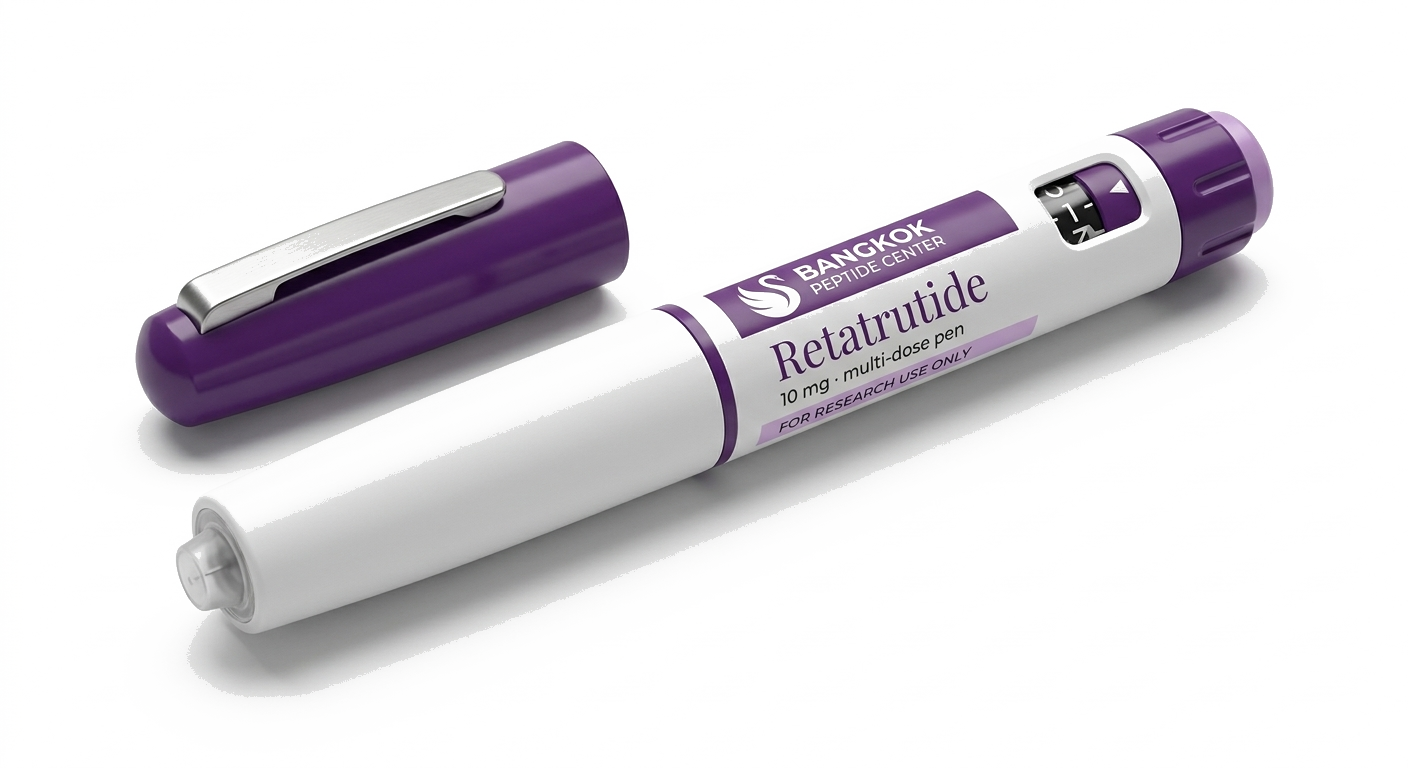
เรทแทรทรูไทด์ 10 มิลลิกรัม
Triple-agonist GLP-1/GIP/Glucagon peptide. Currently the most potent metabolic peptide in clinical trials, showing up to 24% weight reduction in Phase 2 studies.
บีพีซี-157 10 มิลลิกรัม
Body Protection Compound. Extensively researched for tendon, ligament, muscle, and GI tissue repair. 500+ published studies on PubMed.
TB-500 10 มก.
Synthetic Thymosin Beta-4. Systemic healing peptide with strong anti-inflammatory and angiogenic properties. Frequently stacked with BPC-157.
GHK-Cu 50 มก.
Copper peptide with regenerative and anti-aging research backing. Studied for wound healing, collagen synthesis, and skin regeneration.
CJC-1295 + Ipamorelin 10mg
GHRH/GHRP combination stack. Studied for growth hormone stimulation, body composition, and recovery enhancement.
เทซาโมเรลิน 10 มิลลิกรัม
GHRH analogue studied for visceral fat reduction and growth hormone levels. Has the most extensive clinical trial data of any growth hormone peptide.
Melanotan 2 10mg
Melanocortin receptor agonist studied for melanogenesis (skin tanning) and photoprotective effects in research models.
Common questions
Ready to order?
Same-day delivery in Bangkok. 99%+ purity. Bacteriostatic water available separately.
For research and educational purposes only. All products supplied by Bangkok Peptide Center are intended strictly for laboratory research purposes only. They are not medicines, not approved pharmaceutical products, and are not intended to diagnose, treat, cure, or prevent any disease. Always consult a qualified healthcare professional before considering any research compound.